Kudos to Alexa Samuels for laying bare the dangers of not being customer-centric when creating your communications – Is your marketing making the customer think too much?
Begin with the mindset of: Where's my customer's head at regarding my product? and you will, at minimum, prevent customers from bypassing your message since they'll recognize themselves in your piece. At best, you will have gained new brand advocates since you've solved a problem for them and demonstrated respect for their intelligence and time.
On the other hand, if you launch your communications thinking: Hey everyone out there, lemme tell you all my detailed news!, you will likely confuse people who aren't as close to things as you, or worse, create a lasting negative impression of your brand.
Remember the old saw that it takes 100 contacts to create a good impression, but just one to break it!
Showing posts with label strategy. Show all posts
Showing posts with label strategy. Show all posts
Saturday, September 25, 2010


Friday, August 27, 2010
A truly smart brand...
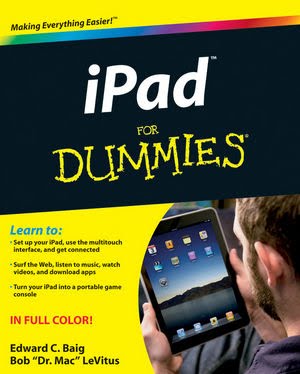
This one is iPad For Dummies, purchased to help me get the most out of my new 'essential business tool / really cool toy' – it really depends on who in my family you ask!
In the early days of Glue, I bought several of the books to help me learn about and run the business: Consulting for Dummies, Accounting for Dummies and Managing Business Change for Dummies. Since then, I've picked up several others – iPod & iTunes for Dummies and iMovie '09 & iDVD '09 for Dummies – to help me exploit specific new technological tools.
What really impresses me about 'For Dummies' books are their consistency:
- Packaging – the books are easy to spot on the store's shelf (helps me buy 'em), and each one is to distinguish from another on my bookshelf (helps me use 'em).
- Organization – each book follows a standard format (e.g., Contents at a Glance, Table of Contents, 'The Part of Tens', road-sign icons, detailed index), so I know what to expect and where to find stuff.
- Tonality – all the Dummies books I own have the same folksy language that's occasionally laced with gentle puns, but always very clear in delivering its message, making me feel comfortable when learning.
Overall, I believe For Dummies books exemplify effective branding: they make a clear and relevant promise ('A Reference for the Rest of Us', now apparently updated to 'Making Everything Easier') and then repeatedly deliver on that promise.
Now that's smart business!
Tuesday, August 10, 2010
How to judge the quality of your constituent communications
Prefer to WATCH this message on YouTube? Click here...
Back in the late 1970s, when I was studying architecture at Carleton University in Ottawa, I was introduced to the phrase: "Well building hath three conditions: firmness, commodity, and delight," which was co-authored by English author and diplomat Sir Henry Wotton (1568 – 1639), in his work The Elements of Architecture (1624; a free translation of Vitruvius' de Architectura).
In essence, the phrase "commodity, firmness and delight" means that an excellent work of architecture is functional (the size and arrangement of its spaces meet the practical needs of its users); well built (it uses materials and technology wisely and efficiently); and pleasing to the eye (it is beautiful or meets the intangible needs of its users).
Since my career has transitioned away from architecture, I've become convinced that all marketing-communications 'artefacts' (whether in print, digital or live media) can also be judged by these same three, time-tested criteria.
In other words, I suggest we should ask ourselves the following questions when assessing 'creative' work:
Perhaps it's time to approach internal stakeholder communications with this same broad yet disciplined perspective? If so, let's talk...
Back in the late 1970s, when I was studying architecture at Carleton University in Ottawa, I was introduced to the phrase: "Well building hath three conditions: firmness, commodity, and delight," which was co-authored by English author and diplomat Sir Henry Wotton (1568 – 1639), in his work The Elements of Architecture (1624; a free translation of Vitruvius' de Architectura).
In essence, the phrase "commodity, firmness and delight" means that an excellent work of architecture is functional (the size and arrangement of its spaces meet the practical needs of its users); well built (it uses materials and technology wisely and efficiently); and pleasing to the eye (it is beautiful or meets the intangible needs of its users).
Since my career has transitioned away from architecture, I've become convinced that all marketing-communications 'artefacts' (whether in print, digital or live media) can also be judged by these same three, time-tested criteria.
In other words, I suggest we should ask ourselves the following questions when assessing 'creative' work:
- Does it accomplish its business objectives – whether that means simply informing, persuading or striving to change behaviour?
- Is it crafted intelligently – completed in a reasonable time, without excessive expenditure, and in a suitably durable yet environmentally friendly manner?
- Does it connect with people and touch their hearts – or at least speak to them as human beings rather than as 'automatons' programmed only to consume?
Perhaps it's time to approach internal stakeholder communications with this same broad yet disciplined perspective? If so, let's talk...
Wednesday, August 4, 2010
'Engaged' employees aren't enough
Until yesterday, I thought that having 'engaged' employees was sufficient as the first step in making customers – and 'shareholders' – happy (i.e., enduring organizational success).
 But then I began reading Hundred Percenters: Challenge your employees to give it their all, and they'll give you even more, by Mark Murphy.
In the book, he argues that the real goal of leaders is not simply to create a workplace where employees are happy or satisfied (i.e., engaged), but rather to make work "fulfilling and enriching and ultimately to position people to achieve great results."
Murphy, who is chairman and CEO of consulting company Leadership IQ, says the two differentiating factors that result in 100% Leadership are 'connection' and 'challenge.' Connection is the strength of the emotional connection that leaders build with their employees, while challenge is how far leaders push their people to achieve greatness.
If you construct a matrix of this factors, you get Avoider leaders (low emotional connection, low challenge); Intimidators (low connection, high challenge); Appeasers (high connection, low challenge); and 100% leaders (high connection, high challenge).
He suggests that Appeasers are satisfied with employee engagement, but that 100% leaders "...push us hard. But when they do, they teach us something about ourselves. They help us achieve extraordinary things. And they give us real opportunities for deep and lasting fulfillment."
To me, most employees indeed want to work in an organization where they can make a tangible contribution, and where they can feel excited and proud about this contribution.
So, I'm going to think about 'energized employees' instead of simply 'engaged employees' as the real objective, with 'being energized' meaning being personally connected to the challenge of achieving great things on the job.

In the book, he argues that the real goal of leaders is not simply to create a workplace where employees are happy or satisfied (i.e., engaged), but rather to make work "fulfilling and enriching and ultimately to position people to achieve great results."
Murphy, who is chairman and CEO of consulting company Leadership IQ, says the two differentiating factors that result in 100% Leadership are 'connection' and 'challenge.' Connection is the strength of the emotional connection that leaders build with their employees, while challenge is how far leaders push their people to achieve greatness.
If you construct a matrix of this factors, you get Avoider leaders (low emotional connection, low challenge); Intimidators (low connection, high challenge); Appeasers (high connection, low challenge); and 100% leaders (high connection, high challenge).
He suggests that Appeasers are satisfied with employee engagement, but that 100% leaders "...push us hard. But when they do, they teach us something about ourselves. They help us achieve extraordinary things. And they give us real opportunities for deep and lasting fulfillment."
To me, most employees indeed want to work in an organization where they can make a tangible contribution, and where they can feel excited and proud about this contribution.
So, I'm going to think about 'energized employees' instead of simply 'engaged employees' as the real objective, with 'being energized' meaning being personally connected to the challenge of achieving great things on the job.
Thursday, July 15, 2010
Leadership insights for not-for-profit executive directors
Ideas for maximizing the contribution of your board of directors
I had the pleasure of serving as ‘scribe’ for a recent kitchen-table dialogue workshop, entitled ‘The NFP Executive Director: Their Leadership and the Role of the Board,’ that was organized and moderated by Alan Kay of The Glasgow Group. The July 6 session was attended by 10 people, most of whom are seasoned not-for-profit (NFP) executive directors (EDs).
The following are some of the key insights and observations for EDs arising from the workshop:
Suggested reading:
Alan Kay’s blog: 8 ways to enhance your Executive Director leadership skills using Solutions Focus;
The 13 commandments of better leadership in NFP organizations; 8 ways to merge your not-for-profit organization and become stronger
Book: The Truth About What Nonprofit Boards Want: The Nine Little Things That Matter Most, by June J. Bradham
I had the pleasure of serving as ‘scribe’ for a recent kitchen-table dialogue workshop, entitled ‘The NFP Executive Director: Their Leadership and the Role of the Board,’ that was organized and moderated by Alan Kay of The Glasgow Group. The July 6 session was attended by 10 people, most of whom are seasoned not-for-profit (NFP) executive directors (EDs).
The following are some of the key insights and observations for EDs arising from the workshop:
- Primary board role is strategic – The board’s fundamental role is to help guide the strategic direction of the NFP. This is frequently initiated by a strategic planning session. “A key ED challenge is avoiding ‘pernicious micro-control’ on the part of the board.” “The board should be ‘nose in, fingers out’ regarding the work of the ED and staff.”
- Board member qualifications – Simply possessing an understanding of, or passion for, the cause is no longer sufficient. Board members today should bring solid skills in such areas as finance, marketing, communications, governance to be considered. Willingness to fundraise on behalf of the organization (cash or in-kind) should be expected.
- Ensure role clarity – One ED described his stakeholders as a triangle, involving his association’s staff, its membership, and its board. Having clearly defined roles enables these three groups to work together. Another said, “My organization can flourish if I’ve been able to forge a relationship with my board chair that’s grounded in trust and discipline.” Another ED prepared a formal governance manual documenting relevant roles, responsibilities and processes.
- Handling board meetings – Recognizing that the ED doesn’t lead or control board meetings, you should still try to be the ‘air traffic controller’ in plotting with the board chair each meeting’s agenda to avoid nasty surprises. Maybe even write the chair’s speaking notes.
- Relationship with board chair – Beware of having too strong a relationship with the board chair, as it can undermine the relationship or commitment of other board members.
- Board training – Initial training only is inadequate. Ongoing education about the board’s role and governance process is essential for boards to keep on delivering value to the NFP. If you’re having difficulty selling this idea, find another NFP that’s doing it and get them to sell its value to your board leaders.
- Staff / board interaction – Consider bringing key staff members to early board meetings to introduce them and help foster trust, role ownership and engagement. But be careful to avoid allowing board members to make direct requests of staff without going through you.
- Permanent board committees – They may not always be necessary; consider striking ad hoc committees driven by specific requirements, which can help reduce the size of your board and lead to faster and better decision-making.
- Be seen in the field – As an ED, you have a ceremonial role to visibly demonstrate leadership and support for the cause by attending local events and activities. Remember to thanks volunteers and staff for their commitment. “People will see what you’re doing more than hear what you say.”
- Who’s the best leader – Question whether the NFP’s founder is still the right person to lead the organization today. Is their passion for the cause impeding current effectiveness now that the NFP has grown and matured? If it is, consider succession planning to get the most appropriate leadership in place.
- Consider alliances or beyond – As the need for NFPs to ‘do more with less’ intensifies, seek out other NFPs with complementary missions with whom you can share resources. If your mandates substantially duplicate one another, even contemplate one NFP acquiring the other to create a stronger organization that’s better able to achieve the mission. Try to look beyond the natural imperative of protecting turf in favour of the greater good.
Suggested reading:
Alan Kay’s blog: 8 ways to enhance your Executive Director leadership skills using Solutions Focus;
The 13 commandments of better leadership in NFP organizations; 8 ways to merge your not-for-profit organization and become stronger
Book: The Truth About What Nonprofit Boards Want: The Nine Little Things That Matter Most, by June J. Bradham
Subscribe to:
Posts (Atom)